

Call center agents often wear headsets for several hours a day. The headset needs to deliver clear voice quality, comfortable wearing and reliable performance during continuous use.
For companies purchasing call center headsets, the main factors are:
Working environment
Connection method
Wearing comfort
Maintenance requirements
Product reliability
A headset used in a small customer service office may have different requirements from one deployed in a large BPO center.
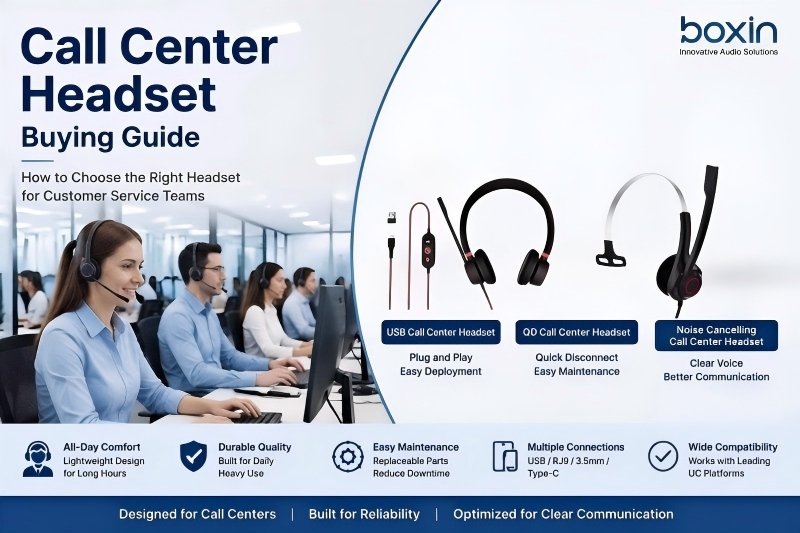
Boxin manufactures call center headsets for global brands, distributors and enterprise customers. Our product range includes USB call center headsets, QD call center headsets and noise cancelling call center headsets for customer service and professional communication applications.
1. Choose a Call Center Headset Based on the Working Environment
Before selecting a headset, companies should first define the working environment and communication system.
Different applications require different headset designs.
Customer Service Teams
Most customer service agents work at fixed desks and handle customer calls through computers or softphone systems.
Typical requirements:
Clear microphone performance
Comfortable wearing during long shifts
Simple connection and setup
For computer-based communication, USB call center headsets are commonly selected because they connect directly to computers and are easy to deploy across multiple workstations.
Learn more about Call Center Headsets.
BPO and Large Call Centers
Large BPO centers often deploy hundreds or thousands of headsets.
Compared with small teams, these projects focus more on:
Fast replacement
Easy maintenance
Long-term operating cost
For these applications, QD call center headsets are widely used.
The QD (Quick Disconnect) design separates the headset from the bottom cable. If the cable is damaged after long-term use, only the cable needs to be replaced instead of the complete headset.
This design helps reduce maintenance time and replacement costs.
Noisy Call Center Environments
Open call centers usually have multiple agents working in the same area.
Common noise sources include:
Nearby conversations
Keyboard sounds
Office background noise
In these environments, microphone performance becomes a key requirement.
Noise cancelling call center headsets use microphone noise reduction technology to reduce surrounding sounds and keep the agent’s voice clearer for customers.
2. Mono vs Binaural Call Center Headsets
The choice between mono and binaural headsets depends on the working environment and user requirements.
Mono Call Center Headset
A mono headset uses one speaker and leaves one ear open.
Common applications:
Customer service teams
Reception desks
Sales teams
The main advantage is that agents can hear both the customer and surrounding conversations.
Mono headsets are suitable for workplaces where employees need to communicate with colleagues while handling calls.
Binaural Call Center Headset
A binaural headset uses two speakers and covers both ears.
Common applications:
Open office call centers
Busy customer service centers
Technical support teams
The two-ear design provides better sound isolation and helps users focus on conversations.
Mono vs Binaural Selection Guide
| Working Environment | Recommended Headset |
| Quiet office | Mono headset |
| Open call center | Binaural headset |
| Long calling hours | Lightweight mono headset |
| High background noise | Binaural noise cancelling headset |
3. USB Call Center Headsets for Easy Deployment
Many call centers use computers and softphone systems for daily customer communication.
USB call center headsets are widely used because they provide a simple connection method.
Key advantages:
Connect directly to computers
Easy setup for new users
Consistent audio performance
USB headsets are commonly used in:
Customer service centers
Sales departments
Technical support teams
For large deployments, using the same USB connection standard also simplifies IT management.
View Boxin USB Call Center Headsets.
4. QD Call Center Headsets for Easier Maintenance
For large call centers, headset maintenance is an important part of long-term operation.
The cable is usually one of the components exposed to the most daily wear.
A QD call center headset allows the headset and bottom cable to be separated.
Available cable options include:
USB
RJ9
3.5mm
Type-C
When the cable is damaged, companies can replace the cable separately instead of replacing the complete headset.
QD headsets are commonly used for:
BPO centers
Enterprise customer service teams
Large headset deployment projects
Learn more about QD Call Center Headsets.
5. Noise Cancelling Call Center Headsets for Clear Voice Calls
For call centers, microphone performance is one of the most important factors.
Customers need to clearly hear the agent even when other conversations are happening nearby.
Common microphone noise reduction technologies include:
ENC
AI ENC
DSP
When evaluating a noise cancelling call center headset, buyers should focus on:
Voice clarity
Microphone pickup performance
Performance in real office environments
A headset that works well in a quiet room may not provide the same result in a busy call center.
Explore Noise Cancelling Call Center Headsets.
6. Comfort and Durability for Long Working Hours
Call center headsets are used every day, often for full working shifts.
Product design directly affects wearing comfort and service life.
Important factors include:
Headset weight
Headband adjustment
Ear pad material
Microphone boom flexibility
Professional headset manufacturers should conduct reliability testing before mass production, including:
Cable bending tests
Plug insertion tests
Boom rotation tests
Headband adjustment tests
These tests help ensure stable performance during long-term use.
7. Connection Options for Call Center Headsets
Different communication systems require different connection types.
| Connection | Application |
| USB | Computer softphone systems |
| RJ9 | Desk phones |
| 3.5mm | Mobile devices |
| Type-C | Modern computers |
Before purchasing, companies should confirm the devices used by agents and select the correct cable configuration.
8. Choosing a Call Center Headset Manufacturer
For brands and distributors, choosing the right manufacturing partner is an important part of product development.
A professional call center headset manufacturer should provide support from engineering development to mass production.
Product Development
Including:
Industrial design
Acoustic development
Electronic engineering
Prototype testing
Manufacturing Capability
Including:
Tooling development
Injection molding
Assembly
Quality control
OEM and ODM Service
Customers may require:
Customized appearance
Logo printing
Cable configuration
Packaging design
Boxin has more than 30 years of headset manufacturing experience and provides OEM and ODM headset solutions for global customers.
Our services cover:
Product development
Engineering verification
Certification support
Mass production
Learn more about OEM & ODM Headset Manufacturing.
Conclusion
Selecting a call center headset starts with understanding the working environment, communication system and maintenance requirements.
Before purchasing, companies should consider:
Noise conditions
Connection type
Wearing comfort
Maintenance needs
Supplier manufacturing capability
USB call center headsets are suitable for computer-based communication. QD headsets provide easier maintenance for large deployments. Noise cancelling headsets help maintain clear voice communication in busy working environments.
Boxin provides call center headset manufacturing services for global brands, distributors and enterprise customers, supporting projects from product development and engineering verification to mass production.
Contact Boxin for your next headset project.